Multi-Agent Review Pipeline for AI Coding Agents
A multi-agent review pipeline for AI coding work separates implementation, independent review, final audit, and risk-based human approval with clear evidence.
Table of Contents11 sections
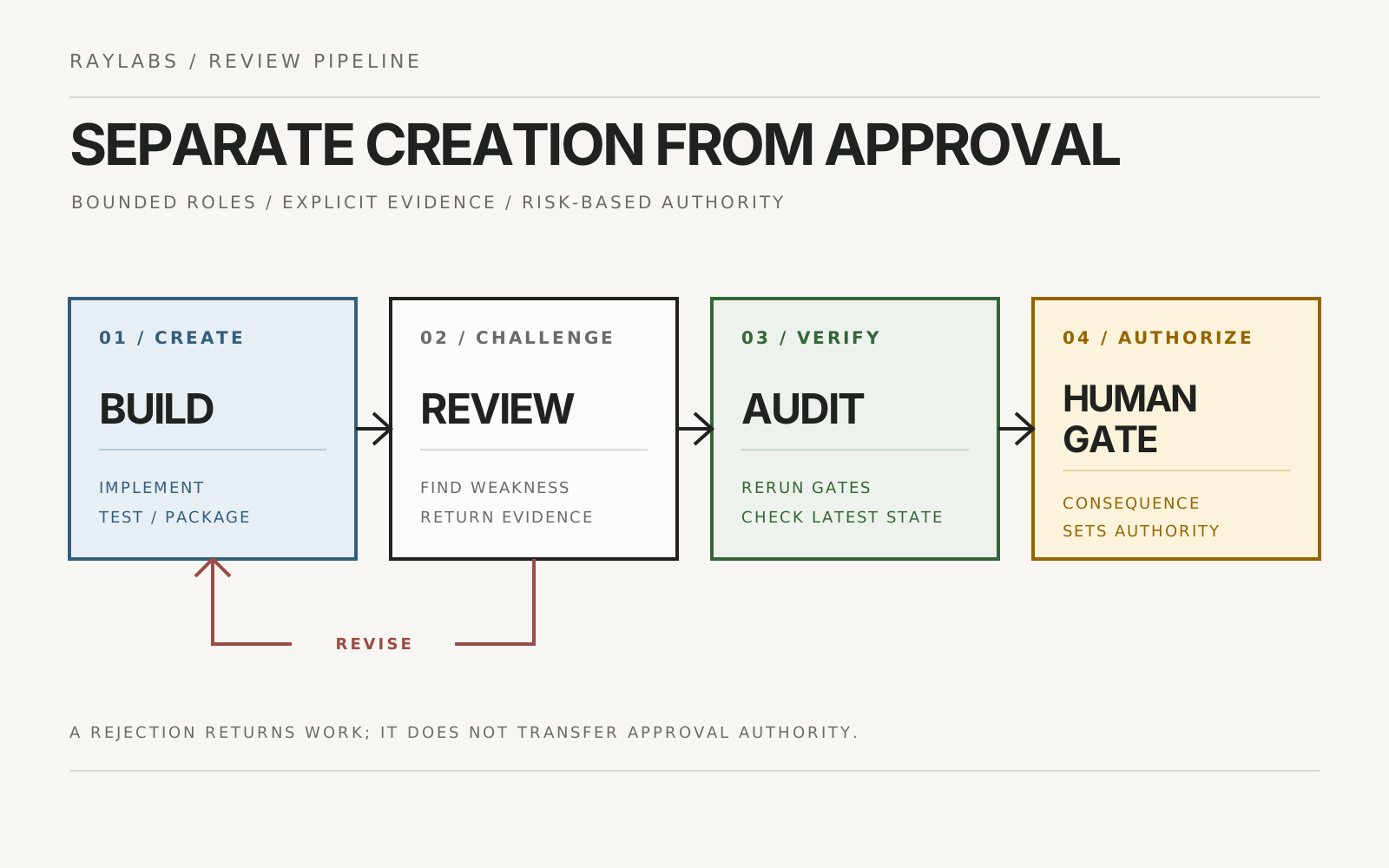
A multi-agent review pipeline addresses a governance problem: the component that implements a change should not be the only component deciding whether its solution is good enough.
Production workflows can add peer review, CI, security checks, release gates, or explicit approval authority. An AI-assisted workflow can use the same principle.
Give each role a different objective, evidence contract, and level of authority.
This article describes a practical four-stage pattern: implementation, independent review, final audit, and risk-based human approval.
The pattern adapts separation of duties to agentic engineering. It does not guarantee that defects disappear. It makes the decision process easier to inspect, challenge, and reproduce.
The Problem With One-Agent Workflows
A minimal agentic coding workflow looks like this:
Requirement
    ↓
AI Agent
    ↓
Implement
    ↓
Run Tests
    ↓
Done
The same agent may be acting as analyst, developer, tester, reviewer, and approver.
That arrangement can preserve blind spots from the implementation path. A second prompt that says “review your work carefully” may improve the result, especially when the agent receives structured verification feedback. It still does not create organizational independence: the same context, assumptions, permissions, and authority remain in place.
Research on language-model self-correction is mixed and task-dependent. Intrinsic self-correction without external feedback can fail or degrade performance, while structured verification can improve correction on particular tasks. The practical lesson is narrower than “self-review never works”:
self-review is useful evidence, but it should not be the only approval control for consequential work.
Think State Machine, Not Group Chat
Putting several agents in one conversation can be useful for exploration, but agreement is not the same as correctness. Multi-agent debate results are sensitive to task and configuration, and more discussion does not automatically create a better decision.
For production work, define a bounded workflow:
TASK_CREATED
     ↓
IMPLEMENTATION_COMPLETE
     ↓
REVIEW_REQUESTED
     ↓
 ┌───────────────┐
 │               │
REJECTED      REVIEW_PASSED
 │               │
 ↓               ↓
REVISION      FINAL_AUDIT
 │               │
 └───────<───────┤ AUDIT_REJECTED
                 │
                 ↓
            AUDIT_PASSED
                 ↓
          HUMAN_GATE_IF_REQUIRED
Each transition has:
- one owner;
- a bounded input;
- a structured output;
- an evidence requirement;
- a terminal or escalation condition.
Without an iteration limit, an implementer and reviewer can continue until a timeout or token budget stops them. A state machine makes that limit explicit.
Role 1: Implementation Team
The first layer owns execution.
Its objective is to understand the goal, decompose the work, make the smallest correct change, and produce something reviewable. A manager-style orchestration pattern can delegate bounded subtasks:
Manager
 ├── Research Agent
 ├── Implementation Agent
 └── Test Agent
This layer may inspect code, edit files, run tests, and iterate. Its permissions should match the task.
It does not receive final approval authority.
Role 2: Independent Reviewer
The reviewer receives the requirement, the resulting change, and the minimum evidence needed to assess it. Its objective is different:
Find where the proposed result fails the stated requirement or creates unacceptable risk.
The review checks:
- requirement interpretation;
- edge cases;
- architecture boundaries;
- concurrency and idempotency;
- error handling;
- security assumptions;
- test coverage;
- maintainability;
- unintended scope changes.
The response should be structured instead of conversational:
ILLUSTRATIVE VERDICT: REJECTED

Critical finding:
- Submission may run twice during concurrent requests.

Required evidence:
- Idempotency behavior.
- A concurrent-request regression check.
The example is synthetic. It is a shape for a review record, not evidence from a production payment system.
The loop may repeat, but it needs a maximum revision count. A repeated failure should escalate to a human instead of producing an endless agent argument.
Role 3: Final Auditor
Passing peer review does not automatically mean that every required gate passed.
The final auditor independently reruns the defined checks against the latest repository state. For a software task, the checklist might be:
Requirements          PASS / FAIL
Implementation        PASS / FAIL
Architecture          PASS / FAIL
Error handling        PASS / FAIL
Security              PASS / FAIL
Edge cases            PASS / FAIL
Tests                 PASS / FAIL
Build                 PASS / FAIL
Regression risk       PASS / FAIL
Documentation         PASS / FAIL
When the required checks pass, the workflow records:
AUDIT_PASSED
This is a logical workflow status, not a cryptographic signature and not a claim that the implementation has no defects.
If the auditor finds a problem, it should return evidence to the implementation layer. It should not silently modify the implementation and then approve its own change.
Final Auditor
     ↓
AUDIT_REJECTED + evidence
     ↓
Implementation Team
     ↓
Independent Review
     ↓
Final Audit Again
Creator, reviewer, and auditor remain distinct roles through the revision cycle.
Evidence Matters More Than Confidence
An agent result should not pass because it sounds confident.
Instead of:
Tests look good.
record:
ILLUSTRATIVE TEST EVIDENCE
Command: project-specific test command
Result: all expected checks passed
Commit: [COMMIT_SHA]
Instead of “no unexpected changes,” inspect the actual diff.
Instead of “requirement implemented,” map each requirement to the relevant change and check.
Evidence supports a decision against the gates that were actually tested. It cannot prove the absence of every defect.
Independence Requires More Than Another Model
Different model families or agent harnesses may diversify failure modes, but they do not guarantee independence.
Useful independence also requires:
- separate objectives;
- fresh verification evidence;
- bounded context;
- independent permissions;
- an authority boundary;
- no hidden reuse of the creator’s verdict.
A conceptual arrangement can look like this:
Orchestrator
     │
     ├── Implementation role
     ├── Versioned task artifacts
     ├── Independent review role
     └── Final audit role
                ↓
          Risk-based human gate
An external agent CLI can be treated as one bounded tool invocation, but the integration contract matters more than the vendor:
Pseudocode only:
review-agent [minimum-review-packet]
audit-agent [minimum-audit-packet]
Use Structured, Sanitized Handoffs
A reliable handoff contains small artifacts, not an entire chat history:
/task
  requirement.md
  implementation-summary.md
  review.json
  audit.json
  evidence/
    change-summary.txt
    test-summary.txt
    build-summary.txt
Every artifact crosses a trust boundary. Repository content, web pages, logs, tool output, and model output should be treated as untrusted because they may contain sensitive values or instruction-like content. Workflow enforcement must prevent source data from changing authority, permissions, or approval rules.
Before a handoff:
- minimize the payload;
- redact secrets, private code, customer data, and local paths;
- keep full diffs inside the authorized repository when possible;
- bind summaries to a commit or content hash;
- restrict access;
- define retention;
- store decisions and evidence, not private chain-of-thought.
Structured handoffs can reduce repeated context, improve recovery, and create an inspectable audit trail when they are versioned and retained safely.
Put Human Approval Where Consequence Justifies It
Not every low-risk task needs a human click.
Human approval is most valuable before consequential actions such as:
- merging into a protected production branch;
- deploying to production;
- changing infrastructure or credentials;
- publishing externally;
- spending money;
- deleting or irreversibly transforming data.
The release packet should be compact:
ILLUSTRATIVE RELEASE PACKET

Task: [TASK]
Implementation: COMPLETE
Independent review: PASSED
Final audit: AUDIT_PASSED
Tests: PASS
Build: PASS
Known risks: [BOUNDED_LIST]
Change: [COMMIT_OR_DIFF_SUMMARY]

Awaiting human approval.
For low-risk and reversible actions, a policy may allow automation after deterministic gates pass.
What This Review Pipeline Controls
The value of a multi-agent engineering system is not the number of agents. It is the clarity of its authority model.
The authority model should answer:
- Who can create work?
- Who can challenge it?
- Who can reject it?
- Who can approve it?
- What evidence is required?
- What happens after rejection?
- Which actions require a human?
Without those rules, adding agents mostly adds conversation.
Start with:
Builder optimizes for completion.
Reviewer optimizes for finding weaknesses.
Auditor evaluates the defined evidence independently.
Human authority scales with consequence.
If you are also deciding where an always-on coding agent should run, see Should Your AI Coding Agent Run on a VPS or Your Mac?.
That separation does not remove uncertainty. It makes uncertainty and authority visible, a better foundation than letting a creator approve its own work.
Continue Exploring
You Might Also Like

How to Automate Medium Publishing Without a New API Token
A practical 2026 workflow for automating everything around Medium publishing while keeping the unsupported provider boundary manual and verifiable.

AI-Assisted Android Development: Build a CI Safety Net Before You Automate
Design a safer AI-assisted Android development workflow with scoped patches, reproducible Gradle validation, dependency checks, risk-based test gates, and human approval.

Understanding MCP Integrations for AI Assistants
An exploration of Model Context Protocol integration patterns, examining how developers connect AI assistants to external databases and services without compromising security boundaries.