Always-On AI Agent Architecture
Explore the structural patterns, tool permissions, and human approval gates required to build reliable, always-on AI agent architectures using GitHub Actions and automated backends.
Table of Contents6 sections

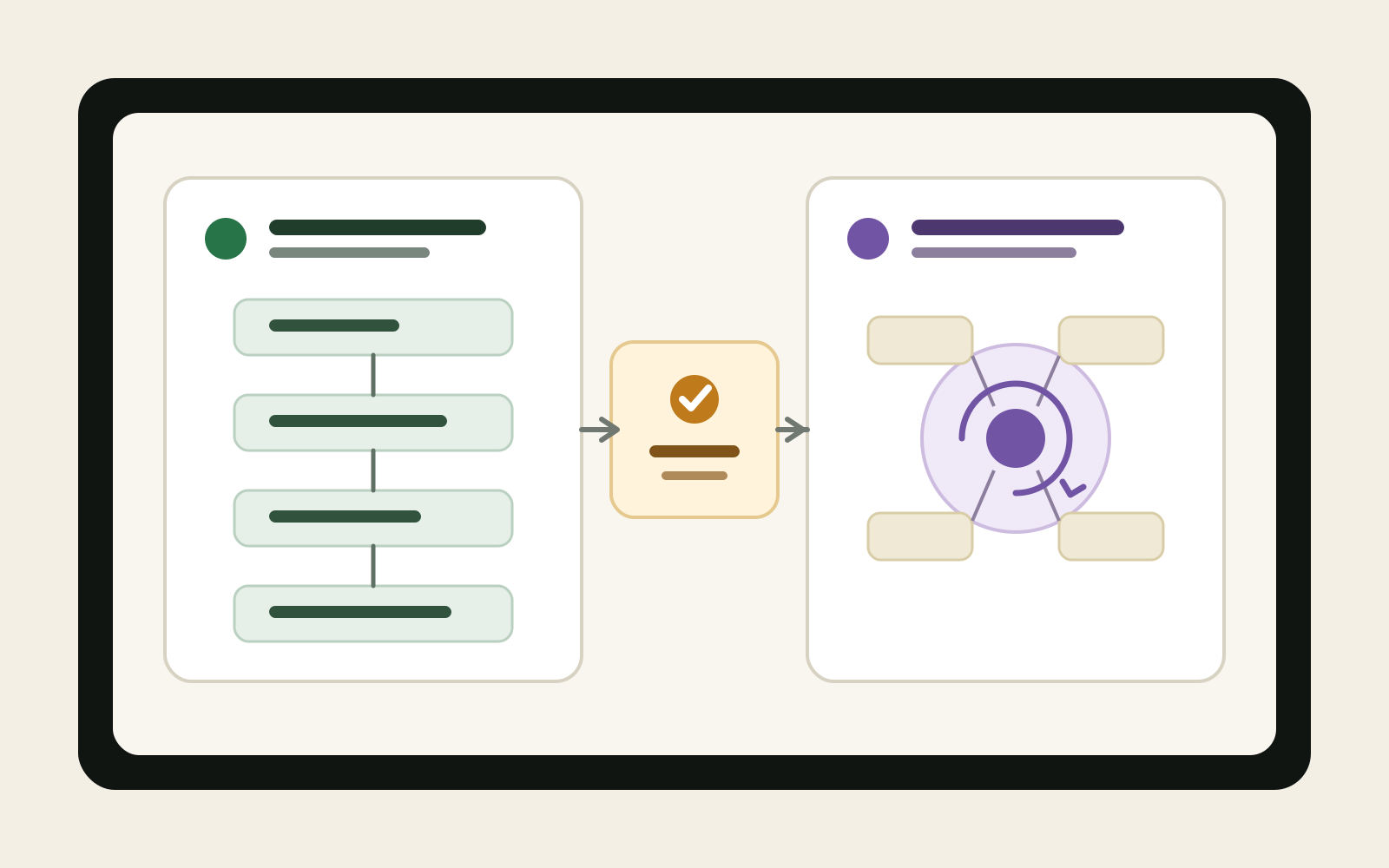
A shared planning surface keeps an always-on agent workflow observable and bounded.
How do you keep an autonomous software agent running continuously while ensuring it maintains correct behavior, secure credentials, and reliable human oversight? Many engineering teams face a fundamental friction point when moving from interactive chat sessions to persistent background workflows. When an Configuring Automated Repository Access assistant operates continuously to process backend tasks, post updates, or invoke developer APIs, it requires a robust architectural foundation. Without clear boundaries, persistent agents consume excessive resources, drift from their intended scope, or execute unverified actions without human consent. This article explores how to design a sustainable, always-on agent architecture by separating durable knowledge from working context, enforcing strict tool permissions, and establishing verifiable execution patterns.
Defining Context Boundaries and State Management
The primary challenge in building a persistent agent is Managing Context Window Limitations In Ai state across asynchronous execution cycles. An always-on agent cannot rely on an endless conversational history stored in volatile memory. Instead, the architecture must separate durable knowledge from temporary working context. Durable knowledge encompasses system prompts, core tool definitions, and long-term project configuration files. Temporary working context includes active task queues, recent API outputs, and intermediate scratchpads generated during execution.
To implement this separation effectively, the backend must serialize agent state into a structured format between runs. When a scheduled trigger or webhook activates the agent, the runner loads only the relevant durable rules and the specific working context required for the current task. This prevents context bloat, reduces token consumption, and ensures the agent does not hallucinate instructions based on outdated conversation threads. Engineers should store this state in isolated storage layers, treating every invocation as a stateless transaction that reads from and writes back to a well-defined data schema.
Enforcing Strict Tool Permissions and Human Approval
Automation brings efficiency, but unconstrained tool execution introduces significant operational risks. An always-on agent often requires access to external APIs, source control systems, and deployment pipelines. Granting unrestricted access to these resources creates vulnerability windows where a misinterpretation of instructions could lead to unintended modifications in production environments.
Security hardening requires a least-privilege permission model for every tool exposed to the agent. If an agent needs to draft a post or trigger a build, the underlying API client must restrict operations strictly to those endpoints. Furthermore, critical state changes require a human-in-the-loop approval gate. For example, an agent can autonomously analyze code, generate documentation, and prepare pull requests, but the final merge or public broadcast must pause until an authorized human reviews the output and provides explicit confirmation. This balance keeps the system efficient while preserving ultimate human control over external-facing actions.
Managing Credentials and Environment Configuration
Configuring runtime environments for persistent agents demands strict adherence to security best practices. Secrets, API keys, and personal access tokens must remain completely outside version-controlled artifacts. Storing credentials directly inside repository configuration files risks accidental exposure if a public commit occurs or if the repository permissions are misconfigured.
Production deployments should inject environment variables dynamically at runtime using secure secret managers or native CI platform vault integrations. The following example demonstrates a secure configuration structure using GitHub Actions, where secrets are passed explicitly to the execution environment without exposing them in the workflow definition file.
name: Persistent Agent Worker

on:
  schedule:
    - cron: '0 */4 * * *'
  workflow_dispatch:

jobs:
  execute-agent:
    runs-on: ubuntu-latest
    steps:
      - name: Checkout Repository
        uses: actions/checkout@v4

      - name: Run Agent Backend
        env:
          API_SECRET_KEY: ${{{{ secrets.AGENT_API_KEY }}}
          ENVIRONMENT: production
        run: |
          python -m agent_backend.runner --config ./config/shared.json
This configuration keeps environment-specific values entirely decoupled from shared project settings. By separating machine-specific credentials from the core codebase, teams can rotate keys seamlessly without altering the underlying agent logic.
Verifying Workflows from a Clean Environment
Testing an always-on agent locally on a developer machine often leads to false confidence. A developer workstation typically contains cached dependencies, global CLI tools, and implicit environment configurations that mask missing dependencies in production. To ensure true reliability, engineers must verify the agent workflow from a clean environment.
CI platforms provide an ideal environment for testing the complete execution lifecycle. Every change to the agent codebase should trigger an automated validation pipeline that provisions a fresh virtual machine, installs required dependencies from lockfiles, and executes a dry run of the agent workflow against a mocked backend. Observing how the agent behaves from a cold start helps uncover silent failures, such as missing package declarations or unhandled timeout errors, before the agent runs in a live setting.
Establishing Observable Failure Signals
Even with rigorous configuration and testing, persistent systems eventually encounter unexpected conditions, such as rate limits, network timeouts, or malformed API responses. An always-on architecture must define observable failure signals and explicit rollback behavior to prevent silent data corruption or infinite retry loops.
Effective observability involves logging structured telemetry data for every agent action. When an error occurs, the runner should capture the exact input state, the failing tool call, and the resulting exception code. Setting up alerting rules based on these structured logs ensures that operations teams receive immediate notifications when failure rates exceed normal thresholds. If an automated task fails halfway through execution, the system must either safely roll back any partial database writes or flag the task for manual inspection rather than attempting blind retries that could compound the error.
Practical Takeaway
Building a sustainable always-on AI agent architecture requires careful attention to context boundaries, explicit tool permissions, and secure credential handling. By separating durable rules from working context, enforcing human approval gates for critical actions, and verifying workflows from clean environments, engineering teams can harness the efficiency of autonomous assistants while maintaining complete control over their systems.
Continue Exploring
You Might Also Like
AI Agent or n8n Workflow? Choose Determinism Before Autonomy
Use deterministic workflow automation for predictable work and AI agents for ambiguous decisions. A practical framework for choosing where each belongs.

Schema-First Gates for Reliable AI Publishing Pipelines
AI publishing gets safer when repository schemas, local validation, CI, deploy checks, and live verification form one explicit chain.

Architecting Autonomous AI Agents with Codex and RayLabs Core
An architectural exploration of integrating autonomous AI agents like Codex into backend workflows, balancing local context isolation with strict evaluation loops.