AI Agent or n8n Workflow? Choose Determinism Before Autonomy
Use deterministic workflow automation for predictable work and AI agents for ambiguous decisions. A practical framework for choosing where each belongs.
Table of Contents9 sections
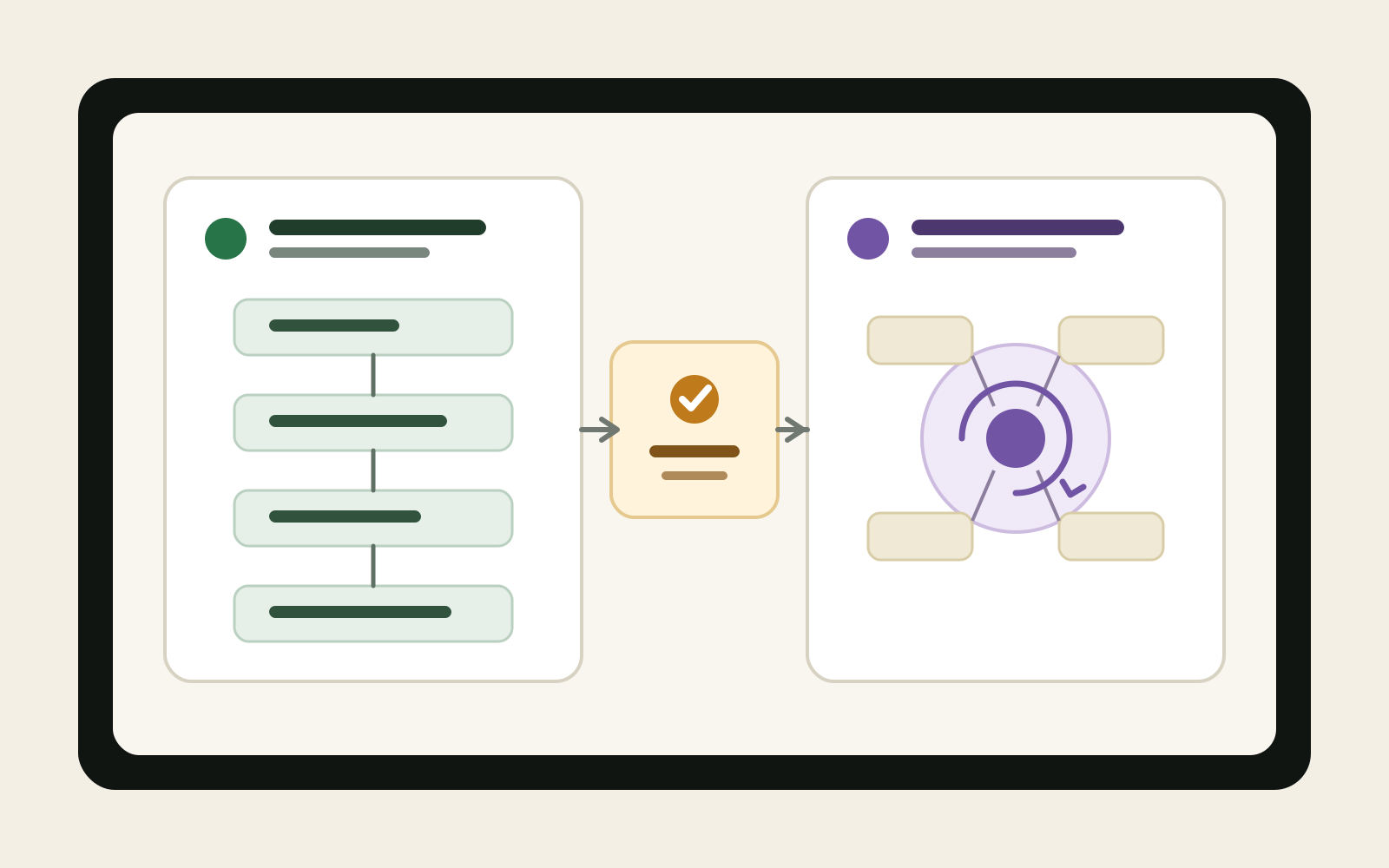
The question “Should this be an AI agent or an n8n workflow?” sounds like a tooling decision.
It is really an uncertainty decision.
If the work is predictable, repeatable, and easy to express as explicit steps, adding an autonomous agent often makes the system harder to debug without adding much value. If the work requires interpretation, tool selection, or adapting to inputs that cannot be enumerated in advance, a deterministic workflow alone can become brittle.
A practical rule is:
Use deterministic automation for known paths. Use an agent only where the path itself must be decided at runtime.
That distinction is more useful than asking which product is more powerful.
Workflow Automation Is Strongest When the Path Is Known
A conventional workflow engine is good at turning a known process into an executable graph:
trigger
  ↓
fetch data
  ↓
validate
  ↓
transform
  ↓
branch on explicit condition
  ↓
call API
  ↓
record result
That model maps closely to how n8n introduces workflows: a trigger starts the process, nodes process data, and explicit logic such as an If node determines which branch runs next. The platform’s first-workflow guide makes that structure visible instead of hiding it behind a model decision.
This gives deterministic automation several useful properties.
The same input usually follows the same graph. Individual nodes can be inspected. Failures can be associated with a specific step. Credentials and integrations can be scoped to the nodes that need them. Retries can be reasoned about without asking why a model chose a different action this time.
For recurring operational work, those properties are often more valuable than flexibility.
Examples include:
- copying validated records between systems;
- scheduled reports;
- applying labels to messages;
- calling a stable API after a known condition;
- transforming a known payload;
- posting a notification after a successful job;
- running a release checklist with fixed gates.
If you can draw the full path before execution starts, a workflow engine should usually own that path.
Agents Are Useful When the Path Cannot Be Fully Enumerated
An agent is different because it can decide what to do next.
n8n’s current AI Agent documentation describes an agent as a system connected to a model and tools where the agent decides which tool to call to complete a task.
That capability matters when the problem is not just “run these steps.”
Consider:
input
  ↓
understand intent
  ↓
decide which tool is relevant
  ↓
inspect result
  ↓
possibly choose another tool
  ↓
stop when the goal is satisfied
The path depends on what the agent observes.
That is useful for tasks such as:
- triaging an unfamiliar support request;
- choosing which repository or document to inspect;
- synthesizing research from several sources;
- diagnosing a failure when the cause is not known in advance;
- converting loosely specified requirements into a structured plan;
- deciding whether a task needs escalation or another tool.
The agent adds value because the branching logic would be expensive or impossible to encode exhaustively.
OpenAI’s practical guide to building agents makes a similar distinction: agents are particularly useful where deterministic and rule-based approaches fall short, while a deterministic solution may be sufficient when that ambiguity is absent.
But that flexibility is also the cost.
The more authority the agent receives, the more carefully you need to define its tools, evidence, stopping conditions, and failure behavior.
The Best Architecture Is Usually Hybrid
The false choice is:
n8n OR agent
A stronger design is:
deterministic workflow
        ↓
bounded agent decision
        ↓
deterministic validation
        ↓
bounded side effect
The workflow owns the skeleton. The agent handles a narrow area of ambiguity.
For example:
Schedule Trigger
      ↓
Fetch new items
      ↓
Filter already-processed records
      ↓
AI Agent:
  classify + choose next action
      ↓
Validate structured output
      ↓
Switch
  ├─ archive
  ├─ notify
  └─ request human review
      ↓
Write audit record
That is very different from giving an agent broad access and saying “manage this process.”
The deterministic layer controls when the agent is invoked, what data it receives, which outputs are accepted, and what happens after the decision.
The agent contributes reasoning without becoming the entire runtime.
This same separation is useful in coding systems. A multi-agent review pipeline works better when implementation, review, evidence, and approval are explicit stages rather than one long autonomous conversation.
A Five-Question Decision Test
Before adding an agent, ask five questions.
1. Can the path be written as explicit logic?
If the answer is yes, start with workflow automation.
A sequence such as “when X happens, fetch Y, compare Z, then send A or B” is not improved merely because a language model can also execute it.
Deterministic logic is cheaper to inspect and easier to test.
2. Is interpretation the actual bottleneck?
An agent becomes more valuable when the hard part is understanding meaning rather than moving data.
For example, distinguishing a routine bug report from a security-sensitive incident may require context that is awkward to encode as a fixed ruleset.
The key is that the ambiguity should be real.
Do not use an agent to compensate for a workflow that has simply not been designed yet.
3. Does the agent need authority or only a recommendation role?
There is a major difference between:
agent recommends: "archive"
and:
agent deletes the record
Start with recommendation or structured classification when the action is consequential.
n8n supports patterns where a workflow can pause for approval before an action. Its Gmail integration, for example, documents a send-and-wait-for-approval operation and explicitly notes its use in human review for AI tool calls.
Human review is not necessary for every low-risk action, but irreversible or externally visible operations deserve a separate authority decision.
4. Can failure be replayed safely?
A mature workflow should make failed runs inspectable.
n8n’s execution history supports filtering execution status and retrying failed workflows using either the current or original workflow.
That operational model is important for agentic systems too.
If an agent chooses badly, can you reproduce the input, inspect the decision, and retry without duplicating a payment, sending the same email twice, or publishing the same content twice?
If not, the missing feature is not a smarter agent. It is idempotency and recovery design.
5. Can you define a stopping condition?
An agent should not keep calling tools simply because another action is available.
Useful stopping conditions include:
- required fields are complete;
- confidence is below a defined threshold, so escalate;
- the requested artifact exists and validates;
- a maximum number of tool calls is reached;
- no safe action remains;
- a deterministic quality gate passes.
An unbounded agent loop is not autonomy. It is an unfinished control system.
When n8n Should Be the Worker
n8n is a good worker when the job is mostly orchestration:
event
→ API
→ transform
→ condition
→ database
→ notification
It is especially useful when the surrounding system already has many SaaS integrations and the operational team benefits from a visible workflow graph.
The workflow engine can own:
- schedules and triggers;
- credentials;
- retries;
- branching;
- API calls;
- data movement;
- audit-friendly execution history;
- human wait states.
Then an agent can be inserted only for the part that genuinely requires interpretation.
This keeps the expensive, probabilistic component small.
When a Dedicated Agent Runtime Makes More Sense
There are cases where n8n should not be the center of the system.
A dedicated agent runtime is a better fit when the primary work is iterative reasoning across tools, such as:
inspect repository
→ form hypothesis
→ run command
→ read logs
→ edit files
→ run tests
→ revise
That loop is not a fixed business workflow with one uncertain node. The reasoning loop is the product.
An always-on coding agent may also need a persistent environment, filesystem, build tools, Git state, and long-running execution. In that case, deciding where the agent should run becomes an infrastructure question rather than a workflow-canvas question.
The orchestration layer can still trigger the agent, capture results, and notify a human. It just should not pretend to be the agent’s execution environment.
The Architecture Boundary That Scales
A useful production pattern is to separate four responsibilities:
| Layer | Responsibility |
|---|---|
| Trigger and orchestration | Start work and move state between steps |
| Agent reasoning | Resolve bounded ambiguity |
| Deterministic validation | Reject malformed or unsafe output |
| Authority | Decide whether consequential side effects are allowed |
That produces a system like:
Trigger
  ↓
Deterministic pre-check
  ↓
Agent reasoning
  ↓
Schema validation
  ↓
Policy gate
  ↓
Action
  ↓
Execution record
Each layer answers a different question.
The workflow asks, “What stage are we in?”
The agent asks, “Given this context, what should happen next?”
The validator asks, “Is this output structurally and operationally acceptable?”
The authority layer asks, “Is this action allowed to happen?”
When those responsibilities collapse into one agent prompt, debugging becomes guesswork.
Start Deterministic, Add Autonomy Where It Earns Its Place
The safest default is not “use an agent.”
It is:
1. Model the deterministic process.
2. Identify where explicit rules become brittle.
3. Put an agent only at that ambiguity boundary.
4. Validate the agent's output.
5. Keep side effects behind explicit policy.
6. Record enough evidence to replay failures.
That approach avoids two common extremes.
The first is over-agentification: using a model for work that should have been a simple workflow.
The second is over-engineered determinism: building hundreds of brittle rules to imitate reasoning that an agent can handle more naturally.
The useful question is therefore not:
“Is n8n better than an AI agent?”
It is:
“Which parts of this system should remain deterministic, and where does ambiguity justify autonomy?”
Once that boundary is clear, the tools stop competing. They become layers in the same architecture.
Continue Exploring
You Might Also Like

Always-On AI Agent Architecture
Explore the structural patterns, tool permissions, and human approval gates required to build reliable, always-on AI agent architectures using GitHub Actions and automated backends.

Schema-First Gates for Reliable AI Publishing Pipelines
AI publishing gets safer when repository schemas, local validation, CI, deploy checks, and live verification form one explicit chain.

Architecting Autonomous AI Agents with Codex and RayLabs Core
An architectural exploration of integrating autonomous AI agents like Codex into backend workflows, balancing local context isolation with strict evaluation loops.