Building a Reliable Batch Publishing Workflow
Learn how to build a resilient, data-driven AI content publishing pipeline on Cloudflare Workers and Cloudflare Workflows, eliminating hardcoded fallbacks and race conditions.
Table of Contents5 sections

A bounded publishing workflow makes each revision, draft, and Debug Broken Links Deployment Flows step observable.
When managing an Purging Generated Artifacts In Automated Workflows pipeline that converts candidate notes into published technical articles, engineers often encounter a familiar set of scaling hurdles. A typical hourly candidate to draft pipeline can accumulate hard coded model fallbacks, topic specific visual patches, duplicated editorial validation checks, and asynchronous deployment races. These issues manifest as excessive Worker subrequests, unexpected rate limit failures, and fragile publication runs that require manual intervention. The production target is to establish a bounded batch mechanism where each run executes one revision, one candidate, and one publication cleanly without relying on external local machinery or brittle continuous integration runners.
To achieve this reliability, engineering teams must evaluate how their orchestration layers handle state and configuration. Traditional serverless setups often scatter provider names, prompt adjustments, and asset mapping across multiple code branches. This approach makes updating a model identifier or adding a new visual asset require a full code deployment. By shifting these changing choices into vault data, the system becomes significantly easier to maintain and audit during unexpected runtime disruptions.
Shifting Configuration From Code to Data
The core architectural decision in a data-driven publishing pipeline is to treat provider model names, fallbacks, and media choices as pure data rather than source code branches. In practice, this means maintaining a centralized model registry that remembers the last successful generative model, along with two bounded fallback options. Similarly, a visual catalog maps reviewed raster assets directly to topic tags and their specific provenance markers. The Cloudflare Worker retains full responsibility for the editorial contract, while the static site repository retains only structural layout, asset verification, slug generation, and duplicate checking logic.
Adopting this pattern introduces specific trade-offs. Hardcoding configuration values inside application code allows for quick, localized hacks, but it creates maintenance debt when upstream APIs change their naming conventions or deprecate specific model versions. Moving configuration into structured data files requires an extra lookup step during execution, which marginally increases memory overhead. However, it decouples the deployment cadence of the worker logic from the rapid iteration cycle of editorial models and asset catalogs. This separation ensures that changing a model parameter no longer risks introducing syntax errors into core routing scripts.
Implementing a Deterministic Cloudflare Workflow
Execution flow requires careful management when operating under strict serverless subrequest ceilings. A single Cloudflare Workflow serves as the runtime orchestrator, executing one deterministic queue item per phase alongside one bounded Pages recheck. This design deliberately sacrifices high throughput for predictable free tier behavior and simplified error recovery. If an upstream API times out or returns a malformed payload, the workflow pauses and preserves its state safely without spawning rogue retry loops.
Consider the following TypeScript interface definition for managing the state machine inside the Cloudflare Workflow. This configuration structure enforces strict boundaries on model selection, fallback behavior, and phase transitions, ensuring that each execution step remains traceable and idempotent.
interface PublishingWorkflowState {
  candidateId: string;
  currentPhase: 'ingest' | 'generate' | 'validate' | 'promote';
  modelRegistry: {
    primary: string;
    fallbackFirst: string;
    fallbackSecond: string;
  };
  retryCount: number;
  maxRetries: number;
}

interface WorkflowExecutionResult {
  status: 'complete' | 'deferred' | 'failed';
  targetUrl?: string;
  errorReason?: string;
}
By typing the workflow state explicitly, the system prevents invalid phase jumps. Each transition checks the persistence layer to confirm whether the operation has already been executed for the given candidate identifier. This pattern stops duplicate writes and ensures that network retries do not generate duplicate articles on the target site.
Enforcing Idempotency and Atomic Commits
Concurrency bugs often emerge when multiple automated triggers attempt to process the same candidate file simultaneously. To prevent these race conditions, the pipeline relies on atomic commits and unique revision markers. When the workflow generates a new draft, it commits the source consumption marker in the exact same git transaction as the generated markdown file. If a concurrent run attempts to modify the same candidate, SHA validation guards stop the operation safely instead of retrying a stale write.
Furthermore, the system verifies the exact public marker, article URL, and hero asset before moving a vault draft from the draft directory to the published directory. This verification step prevents broken links and ensures that human readers never encounter a stub page missing its required visual assets. Safe deferral mechanisms ensure that transient network failures trigger a clean pause rather than a corrupted partial deployment.
Verification and Operational Checklist
Before promoting any automated publishing workflow to production, engineers must execute a rigorous local and remote verification checklist. Skipping these validation steps can lead to subtle runtime exceptions that only appear under production traffic loads. The following table summarizes the validation stages and their expected outcomes.
| Verification Stage | Command or Action | Expected Outcome |
|---|---|---|
| Type Safety & Tests | npm test && npm run typecheck |
Zero errors or failing assertions |
| Local Dry Run | npx wrangler deploy --dry-run |
Valid worker bundle and configuration |
| Workflow Execution | Inspect Workflow dashboard | Returns complete with PROMOTED status |
| Asset Availability | HTTP check on public endpoints | Returns HTTP 200 for article and assets |
| Vault Transition | Git status inspection | Removes draft file, creates published file |
Executing these checks in sequence guarantees that the deployment bundle is structurally sound and functionally complete. Engineers should automate these verifications within their local development loops to catch configuration drifts early.
Practical Takeaway
Building a dependable AI content publishing pipeline requires disciplined separation between runtime logic and dynamic data. By utilizing Cloudflare Workflows with explicit state management, data-driven model registries, and atomic git operations, teams can eliminate the fragile race conditions common in traditional serverless automation. The key is to treat failures as normal operational events that trigger safe deferrals rather than aggressive retries. Begin by migrating your configuration parameters out of source code and into structured data files to establish a predictable, maintainable foundation.
Continue Exploring
You Might Also Like
Android ABI Filters: How to Choose Architectures Without Breaking Devices
A practical guide to Android ABI filters, native library packaging, 32-bit and 64-bit support, and testing architecture choices across real devices.
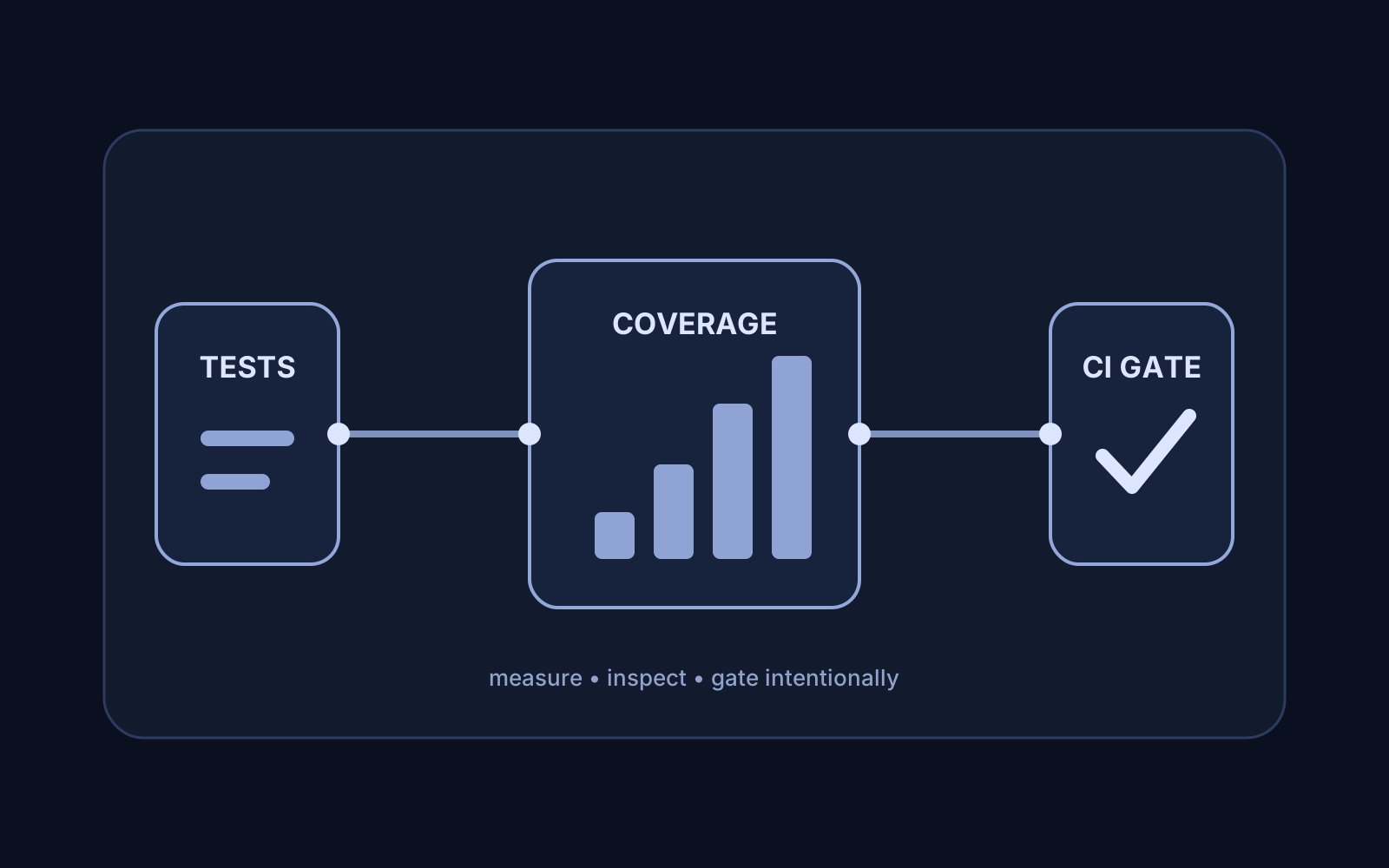
Android Code Coverage in CI Without Chasing a Meaningless Percentage
Build useful Android coverage gates with JaCoCo, variant-aware reports, CI artifacts, and thresholds that protect behavior instead of rewarding test-count theater.
How to Check Android Connectivity Without Lying to Your UI
Use ConnectivityManager and NetworkCapabilities as signals, not promises, and design Android networking around validated state, retries, and real request outcomes.