Notion or Obsidian for a Personal Knowledge Base? Start With the Storage Model
Choose between Notion and Obsidian by deciding what should own your knowledge: a cloud workspace or durable local Markdown files.
Table of Contents9 sections

The usual Notion-versus-Obsidian debate starts with features.
Which editor feels better? Which app has nicer databases? Which one has a graph? Which one looks more polished?
Those questions matter, but they are downstream of a more important architectural decision:
What do you want your knowledge base to fundamentally be?
If you want a cloud workspace that happens to contain your knowledge, Notion is a strong fit. If you want your knowledge to remain a directory of ordinary files that many tools can understand, Obsidian starts from the more durable foundation.
That distinction becomes increasingly important once a note system grows beyond casual note-taking and starts feeding scripts, Git workflows, AI agents, publishing pipelines, or long-lived technical documentation.
The Storage Model Is the Real Fork in the Road
Obsidian stores notes as plain-text Markdown files inside a local folder called a vault. Because those notes are normal files, other editors and file-management tools can work with them directly. Obsidian can also observe external changes to the vault. That makes the filesystem itself part of the architecture rather than an implementation detail.
Notion takes the opposite approach. Your workspace lives in Notion’s cloud service. Notion provides exports, including Markdown for regular pages and CSV for full-page databases, so the data is portable, but the exported representation is not the workspace itself. Notion explicitly notes that you cannot instantly recreate a workspace simply by re-uploading an export.
That difference sounds subtle until you automate something.
With a Markdown vault, an automation can often operate on the same artifact you edit:
Human edits note.md
       ↓
Git / script / AI agent reads note.md
       ↓
Automation updates metadata or creates another .md file
       ↓
Obsidian sees the changed files
There is no mandatory conversion boundary in that loop.
With a cloud workspace, integrations usually operate through the product’s supported interfaces or through exported representations. That can be excellent for collaboration, but it means the application remains the primary system of record.
Why Notion Often Feels Better Immediately
Architecture is not the only thing that matters. Friction matters too.
Notion’s appeal is easy to understand: a workspace can combine pages, databases, structured properties, project views, and collaborative content without asking you to think about folders, Markdown syntax, Git, or synchronization topology.
That is a meaningful advantage for teams and for people who want the interface to do more of the organizational work.
A knowledge system that is theoretically durable but unpleasant to use will eventually become an abandoned folder.
So choosing Obsidian merely because Markdown is open would be too simplistic. If the primary job is collaborative planning, shared databases, and visually structured workspaces, forcing everything into local Markdown can create more maintenance than value.
The right question is not which product is more powerful.
It is where you want complexity to live.
Notion absorbs more complexity into the application. Obsidian exposes more of the underlying file system to you.
Why Obsidian Gets More Interesting as Automation Grows
Local Markdown becomes unusually useful when your notes stop being passive documents.
Suppose a knowledge base feeds several workflows:
Conversation archive
        ↓
Sanitized notes
        ↓
Markdown knowledge base
   ↙         ↓          ↘
Git       AI agent     Website
Each consumer can read the same durable files. You can inspect diffs. You can grep the repository. You can back it up with ordinary tools. You can build deterministic scripts around filenames and frontmatter. You can migrate editors without first migrating the underlying prose.
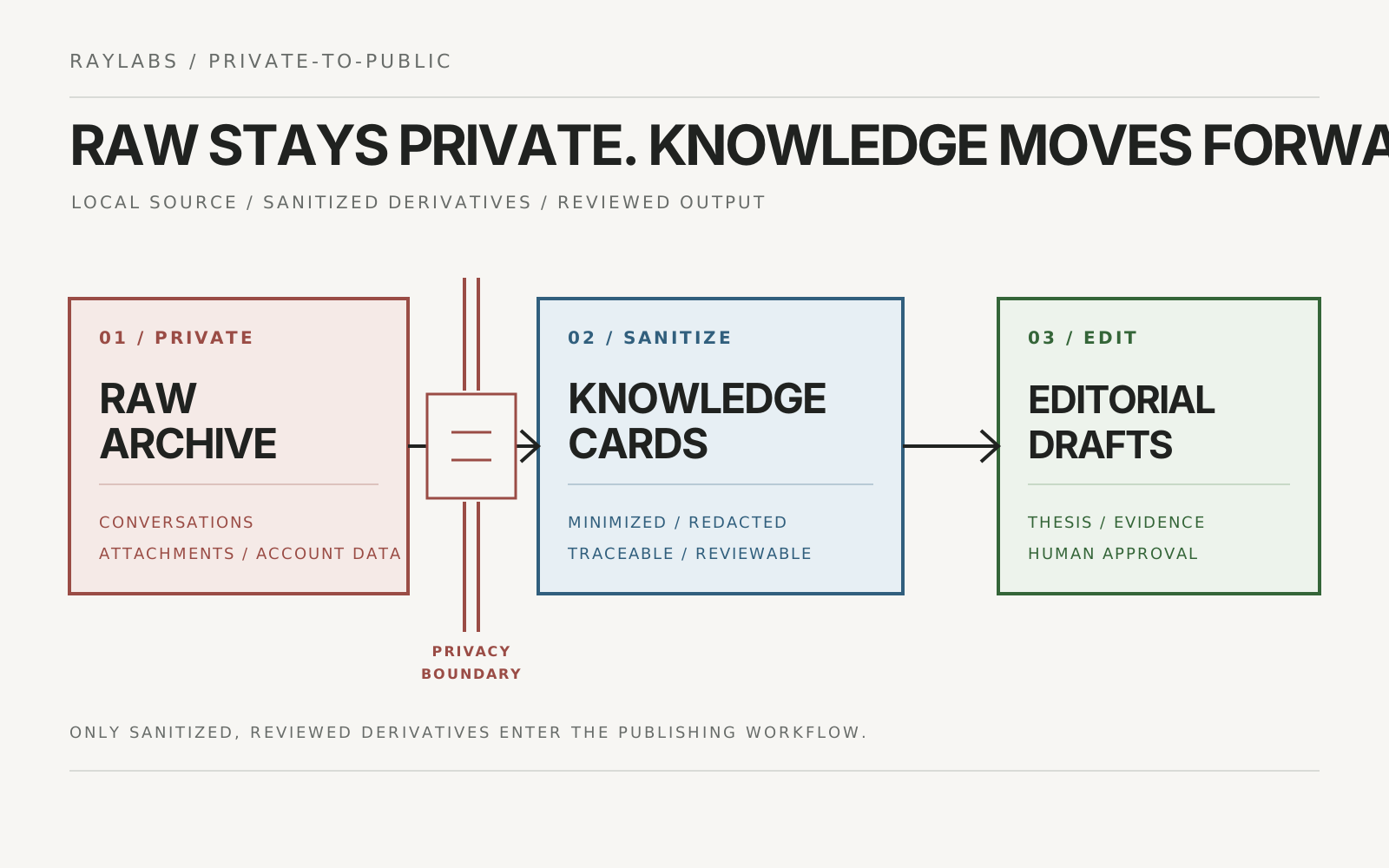
This is closely related to the architecture behind a privacy-first AI conversation archive: raw material and publishable knowledge should be separated, and the durable intermediate representation should be easy to inspect.
For developers, that inspectability is a major advantage. The knowledge base behaves less like a destination app and more like infrastructure.
Sync Is Where Local-First Stops Being Free
There is a trade-off.
Once files are local, you become responsible for deciding how they move between devices.
Obsidian’s official documentation describes several approaches: its first-party Obsidian Sync service, third-party cloud storage, local synchronization tools, and version-control-based approaches such as Git. The flexibility is valuable, but flexibility creates choices and failure modes.
A cloud-first product hides much of that problem. You sign in and the workspace is there.
A local-first system makes synchronization an explicit architectural layer:
Device A ─┐
          ├─ synchronization strategy ─ canonical knowledge
Device B ─┘
That is why a good Obsidian setup needs more than “put the vault somewhere and hope.” Conflicts, offline edits, mobile behavior, and backup should be deliberate.
If Git-based synchronization fits your workflow, Ray Vault Sync is one example of treating sync as a visible system with conflict handling rather than pretending distributed files never collide.
Portability Is More Than Having an Export Button
Both systems can give you data outside the application, but there are two different kinds of portability.
Export portability means you can ask a system to produce a transferable copy.
Native portability means the working data is already stored in a broadly usable format.
Notion supports exporting workspace content as HTML, Markdown, and CSV depending on the content type, and its documentation positions those exports as a way to keep your information portable and create your own backups.
That is good product behavior.
But it is still different from editing Markdown files that already exist on your disk.
This distinction matters most when you imagine the boring future scenario: five years from now, you want to change tools.
With native files, migration can be as small as opening the folder with another application. With exported data, migration starts with a conversion step, and application-specific structures may not map perfectly.
A Better Decision Matrix
Instead of comparing feature checklists, compare the system you are actually trying to build.
| Requirement | Notion | Obsidian |
|---|---|---|
| Fast cloud workspace setup | Strong | Requires more decisions |
| Shared team workspace | Strong | Possible, but not its simplest model |
| Local plain-text source of truth | Exportable, not native | Native |
| Git-friendly knowledge | Indirect | Natural fit |
| Script and CLI access to notes | Integration-dependent | Direct filesystem access |
| Structured visual databases | Core strength | Possible with plugins/workflows |
| Offline file ownership | Export/backup workflow | Core storage model |
| Sync simplicity | Mostly product-managed | User chooses the sync architecture |
| Long-term editor independence | Good export path | Strong native portability |
The table does not produce a universal winner. It exposes the trade.
The Hybrid Answer Is Often Better Than Picking a Side
There is no rule saying one application must own every kind of information.
A practical split can be:
Notion
Shared plans
Team databases
Collaborative operating docs

Obsidian
Personal notes
Technical knowledge
Long-lived references
Automation inputs
Drafts and research
The important part is to avoid creating two competing sources of truth for the same material.
Give each system a job.
For example, a project status table can live in Notion while the durable technical reasoning, architecture notes, and reusable lessons live in Markdown. The boundary is clearer than attempting fragile bidirectional synchronization between every page in both systems.
Choose Based on What You Want to Own
If the interface is the product you care about most, Notion is compelling. It removes a lot of infrastructure decisions and makes structured collaborative information approachable.
If the files are the asset you care about most, Obsidian has the cleaner model. The editor can change while the underlying knowledge remains ordinary Markdown.
For a personal knowledge base that I expect to connect to code, Git, AI workflows, and publishing, I would make Markdown the canonical layer and treat the editor as replaceable.
For a collaborative workspace where databases, shared views, and low setup friction dominate, I would choose Notion without feeling that I had selected the “less technical” option. It is simply optimizing a different layer.
The useful conclusion is not Notion versus Obsidian.
It is:
cloud workspace versus local-first knowledge infrastructure.
Once you decide which of those you are actually building, the tool choice becomes much easier.
Continue Exploring
You Might Also Like

Structuring Reusable Templates and Documentation
Learn how to structure reproducible templates and README files for cross-functional developer tools and multi-platform projects.

Writing Technical README Instructions for Resilient Android Projects
A comprehensive guide on creating technical README instructions that promote resiliency, ease of setup, and long-term maintainability for Android software projects.
ChatGPT Export: Privacy-First Knowledge Cards
Turn a ChatGPT export into reusable technical notes with a local-first workflow that keeps raw conversations, attachments, and publishing inputs separate.