Zero Trust Adoption Roadmap: Map Current State Gaps
Learn how to build a measured Zero Trust adoption roadmap by auditing current-state access gaps across identities, devices, and resources before setting targets.
Table of Contents5 sections
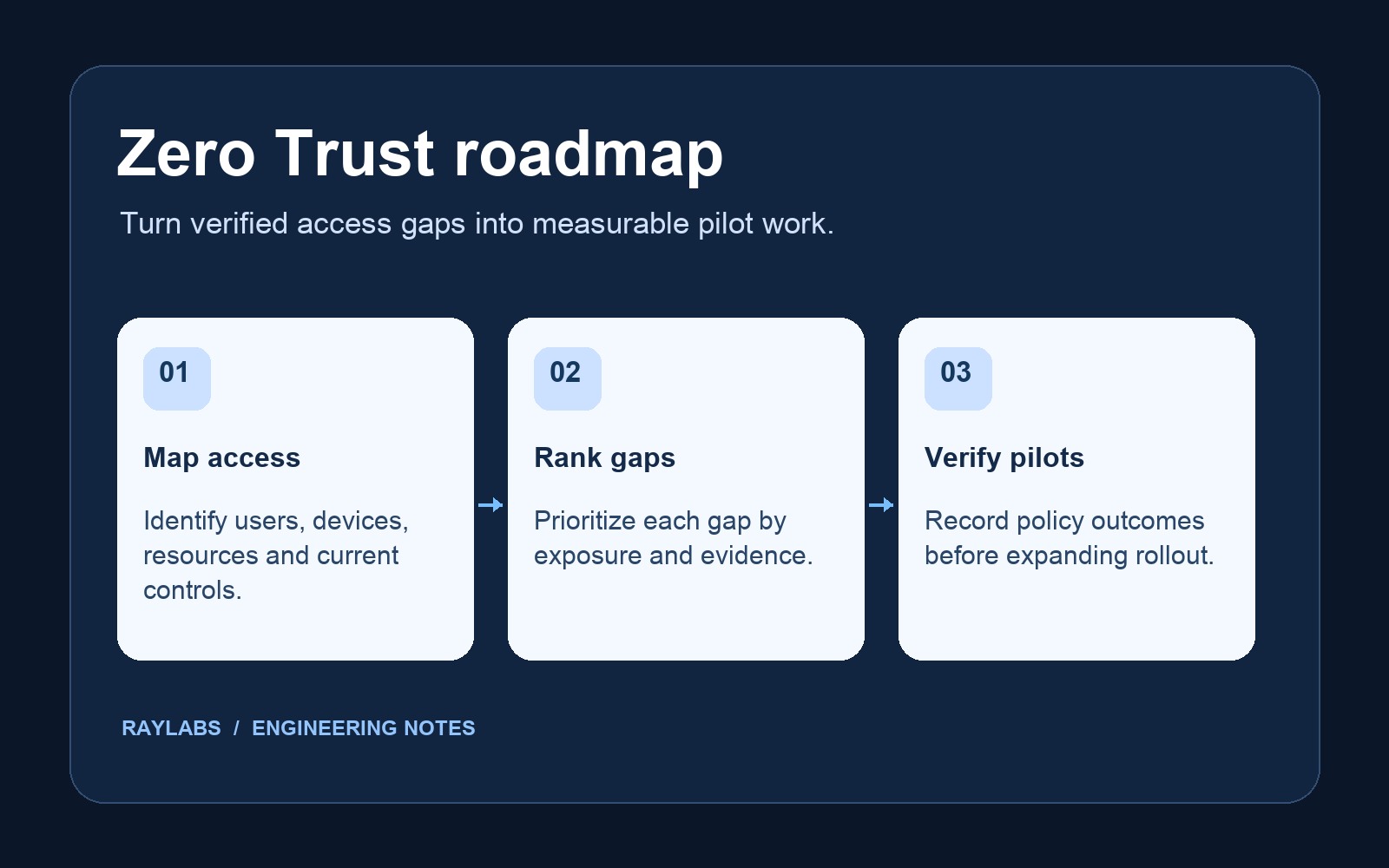
Security teams often jump directly into vendor product procurement without establishing how implicit network trust operates in their environment today.
Quick solution: Define a current-state resource inventory using a structured JSON gap audit schema to map identities, devices, and access policies before defining targets:
{
  "resource": "billing-api",
  "identity_provider": "oidc-okta",
  "device_compliance_checked": false,
  "implicit_network_trust": true,
  "policy_decision_point": "perimeter-firewall"
}
Starting with explicit visibility into resource dependencies prevents organizations from treating security reform as a simple software installation.
Understanding Current State Access Gaps
Zero Trust is an architectural framework centered on continuous evaluation rather than static perimeter defenses. As detailed in the NIST SP 800-207 Zero Trust Architecture guidelines, access decisions should explicitly verify identity, context, and risk state for every request regardless of network position.
Many organizations attempt adoption by applying vendor solutions over unmapped access paths. This creates policy gaps where internal networks still grant implicit authorization based solely on IP ranges or VPN membership. A successful zero trust adoption roadmap current state gaps evaluation begins by cataloging four core pillars:
- Resources: Applications, microservices, databases, and administrative endpoints.
- Identities: Human users, service accounts, automated pipelines, and third-party integrations.
- Devices: Managed endpoints, mobile hardware, and ephemeral build nodes.
- Access Paths: Existing networks, reverse proxies, decision points, and legacy firewalls.
Documenting these components reveals where explicit verification is absent, allowing engineering leads to plan targeted policy upgrades.
Evaluating Roadmap Scenarios and Technical Strategies
Transitioning from implicit trust to continuous verification requires choosing the right enforcement model for each resource category. The decision table below compares core approaches for bridging access gaps:
| Strategy Option | When to Use It | Trade-off or Failure Mode | Recommendation |
|---|---|---|---|
| Gateway Proxy Pattern | Ingress access to legacy internal web applications | Adds latency and requires centralized proxy maintenance | Ideal for web apps that lack native modern identity protocols |
| Mutual TLS (mTLS) Mesh | Service-to-service communication inside Kubernetes or microservices | Certificate lifecycle complexity and secret rotation overhead | Deploy for high-throughput internal microservice networks |
| Identity-Aware Proxy (IAP) | Remote worker access to cloud-hosted management portals | Third-party identity provider dependency during outages | Standardize across administrative endpoints and internal portals |
| Network Microsegmentation | Hybrid enterprise workloads spanning physical data centers | Fragile firewall rule sets if application dependencies are unmapped | Use as a secondary isolation layer, not a replacement for identity |
When organizing access reviews across decentralized security teams, designing async handoffs for remote enterprise teams helps ensure that policy exceptions receive prompt review without blocking deployment workflows.
Establishing Baseline Measurement Boundaries
Progress cannot be measured without clear baseline metrics established before implementation begins. Guidance from NIST CSWP 20 on Planning for a Zero Trust Architecture emphasizes phased adoption based on clear operational boundaries rather than blanket organization-wide mandates.
Avoid vanity metrics such as percentage of tools installed or vendor deployment timelines. Instead, focus on verifiable control coverage metrics:
- Explicit Verification Ratio: Percentage of internal endpoints requiring multi-factor authentication and device posture checks before session establishment.
- Implicit Trust Boundary Reduction: Count of internal IP subnet ranges that grant unrestricted network access without layer-7 authentication.
- Exception Lifespan: Average duration that temporary access policy overrides remain active in production environments.
Additional execution guidance from the Microsoft Zero Trust adoption framework underscores that security posture improves incrementally as policy enforcement points transition from network perimeters to granular resource boundaries.
Roadmap Execution and Verification Checklist
Validate your initial roadmap milestones with this four-step verification sequence:
- Audit Resource Coverage: Execute an asset inventory scan across production subnets and cloud endpoints. Expected result: Catalog 100% of production services, automated service accounts, and assigned identity providers in an explicit asset registry.
- Validate Policy Decision Points: Submit a test request from an unmanaged endpoint using valid identity credentials. Expected result: The policy decision point actively blocks request routing at the gateway prior to resource access.
- Inspect Exception Telemetry: Initiate a temporary administrative access override and review security operational logs. Expected result: Security audit logs register the exception start time, requesting identity context, and automatic policy expiration event.
- Benchmark Verification Overhead: Measure request latency during identity assertion and device posture verification. Expected result: Identity and posture checks complete within target operational boundaries without interrupting application availability.
Continue Exploring
You Might Also Like

Safe AI Provider Failover Error Logging
Learn how to structure multi-provider AI failover logs safely to preserve primary failure context while preventing API key exposure.

Sanitize Context Before Every Model Review Call
Learn why treating every LLM call as a distinct privacy boundary is essential to prevent sensitive data leakage, and how to implement robust sanitization for reviewer models.

AI Hiring Bias Assessment Checklist
Learn how to identify and mitigate bias in recruitment AI by implementing concrete product requirements, transparency controls, and human-in-the-loop oversight.