Structuring Reusable Templates and Documentation
Learn how to structure reproducible templates and README files for cross-functional developer tools and multi-platform projects.
Table of Contents5 sections

A collaborative developer Designing A Photo Backup Workflow In Modern Mobile Apps with multiple tools and decisions in play.
When scaling modern software engineering teams across diverse frontend, Shipping Mobile Features Without Releasing A New Apk, and cloud environments, maintaining consistency becomes a significant operational bottleneck. How do you ensure that every new repository starts with a predictable foundation without forcing developers to manually copy configurations across dozens of projects? The answer lies in treating project templates and configuration README files as first class software artifacts. By establishing clear structural baselines, separating machine-specific values from shared project settings, and maintaining permanent context about architectural decisions, teams can drastically reduce configuration drift and onboarding friction.
This article examines the core strategies required to design robust project templates and comprehensive documentation. We will explore how to organize configuration files, handle custom adapters without cluttering the core codebase, and verify deployment readiness from a completely clean environment. Whether you are managing flagship templates or exploring new automation workflows, establishing a structured approach ensures long term maintainability and predictable execution across all target platforms.
Establishing Core Template Architecture
The foundation of any reusable template system is a clean separation of concerns between shared baseline structures and environment specific variables. When flagship templates are fully stabilized, engineering teams often shift their focus toward specialized extensions or custom adapters. However, introducing too many options too early can overwhelm new users and make the base template difficult to maintain. The key is to establish a minimal viable core that satisfies ninety percent of standard use cases while providing well defined extension points for custom requirements.
In practice, this means structuring your repository layout so that configuration files, schema definitions, and executable scripts reside in predictable directories. Developers should be able to inspect the root directory and immediately understand where application logic lives, where configuration schemas are defined, and how deployment workflows are triggered. By keeping environment configuration and sensitive credentials strictly outside version controlled artifacts, you prevent accidental leaks and ensure that the template remains safe to distribute across public and private registries alike.
Furthermore, when designing custom adapters, you must ensure they adhere to strict interface contracts. If a template expects a specific JSON payload format or API interaction pattern, any custom adapter must conform to those exact specifications. This prevents downstream consumers from encountering unexpected runtime errors when swapping out underlying implementations. Documenting these extension points clearly within the project README ensures that future maintainers understand how to extend the system without breaking core functionality.
Writing Actionable and Comprehensive README Files
A template is only as useful as its documentation. If a new contributor cannot spin up the project from a completely clean environment within minutes, the template has failed its primary objective. A robust README file must move beyond simple installation commands and provide deep architectural context, verification steps, and troubleshooting guidance.
Begin with a concise overview of what the template provides and which platforms or environments it supports. Follow this with a step-by-step quickstart guide that assumes nothing about the host machine other than the presence of standard runtime tools. Crucially, verify this workflow regularly from a pristine environment rather than relying on an already-configured developer workstation where global dependencies might mask missing setup steps.
Documentation should also explicitly cover lifecycle states, state restoration procedures, and compatibility matrices across supported platform versions. When things go wrong, developers need immediate visibility into failure signals and rollback behaviors. By outlining common error scenarios and their corresponding resolutions directly in the documentation, you minimize support overhead and empower teams to resolve configuration issues independently.
Managing State and Context Across Reusable Workflows
As projects evolve, maintaining alignment between actual code implementation and documented conventions requires deliberate effort. One of the most effective strategies for long term project health is preserving assistant-side technical guidance and architectural decisions in a structured manner. When teams onboard new members or spin up automated code generators, having a permanent record of why certain structural choices were made prevents the reintroduction of discarded anti-patterns.
This contextual preservation involves documenting not just the how, but the why. For instance, if a specific JSON schema was chosen over another API serialization format, recording that decision in the project documentation prevents future contributors from refactoring the code away from the required standard without realizing the downstream consequences. Similarly, keeping track of template versions, adapter extension points, and deprecation schedules ensures a smooth upgrade path as underlying dependencies mature.
When exploring new tooling or expanding into additional platform targets, modularity becomes paramount. You should design your template configurations so that new components can be slotted in without requiring a complete rewrite of the existing codebase. This modularity allows teams to adopt incremental improvements without disrupting active development pipelines.
Verifying Deployment Readiness and Operational Safety
A well structured template must include automated mechanisms to verify its own integrity. Before releasing a template version to your organization, run comprehensive validation checks that simulate real world deployment scenarios. These checks should cover multiple operational states, including loading states, empty datasets, successful execution paths, and failure recovery routines.
Define explicit deployment evidence requirements and observable failure signals. When a build fails or a configuration parameter is missing, the system should log clear, actionable error messages rather than failing silently or producing cryptic stack traces. By embedding these validation checks directly into the template lifecycle, you ensure that every project initialized from the template inherits a high standard of operational reliability from day one.
Practical Takeaways
- Separate shared project settings from machine-specific configuration values to prevent environment drift.
- Test your template setup workflows from a completely clean environment to catch missing dependencies early.
- Design custom adapter extension points with strict interface contracts to maintain core system stability.
- Document lifecycle states, error signals, and rollback procedures clearly within your README file.
Continue Exploring
You Might Also Like

Writing Technical README Instructions for Resilient Android Projects
A comprehensive guide on creating technical README instructions that promote resiliency, ease of setup, and long-term maintainability for Android software projects.
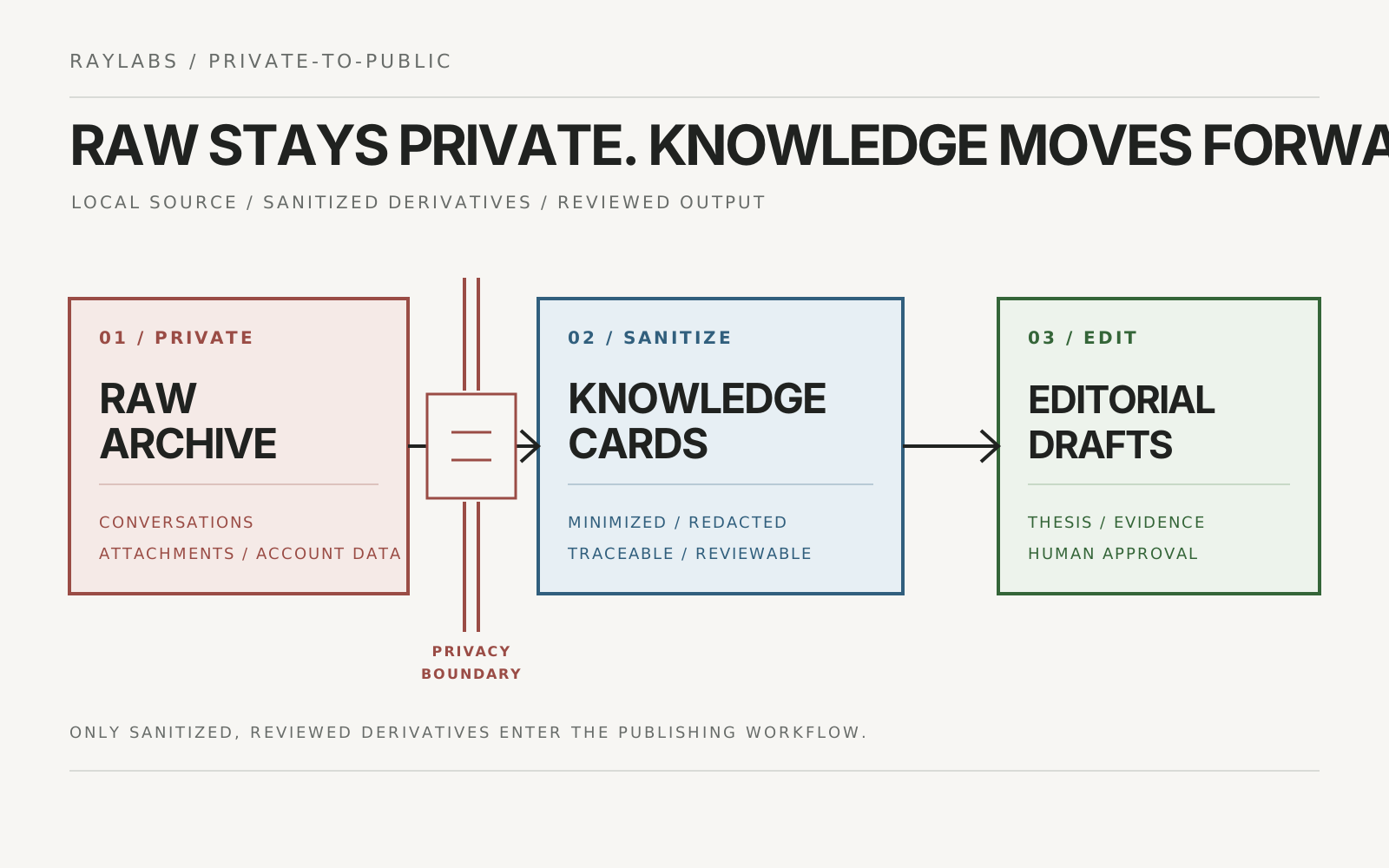
ChatGPT Export: Privacy-First Knowledge Cards
Turn a ChatGPT export into reusable technical notes with a local-first workflow that keeps raw conversations, attachments, and publishing inputs separate.

Mastering List to String Conversion in Mobile Development
An in-depth guide on handling list to string conversion, managing Android lifecycles, and avoiding memory leaks during state transformation.