CSV Import Versus API Integration for B2B SaaS
Learn when to use CSV imports to validate B2B workflows before committing to complex API integrations, and how to manage the associated security and data risks.
Table of Contents1 sections
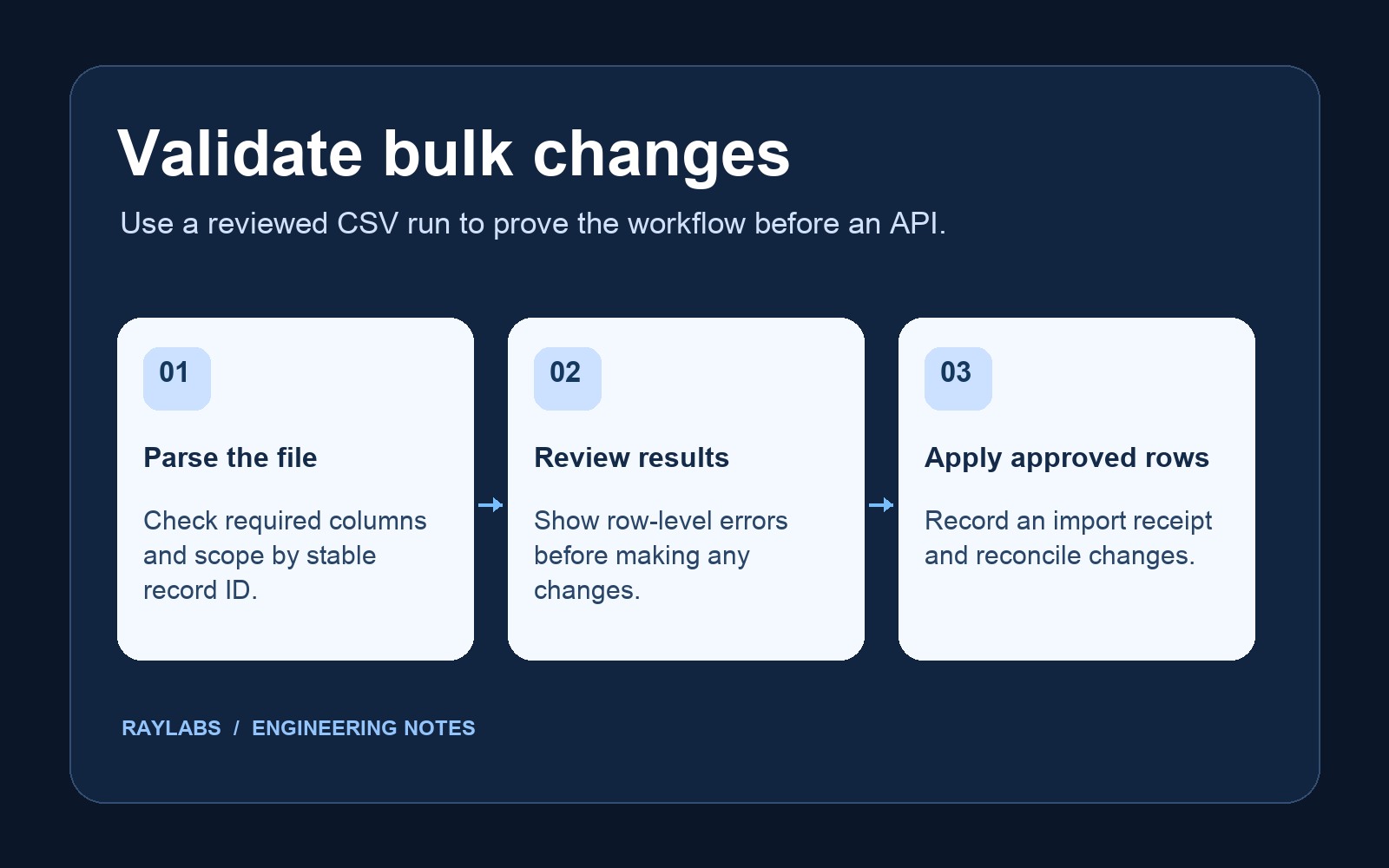
When building B2B SaaS products, choosing between a CSV import and a full API integration often feels like a permanent architectural decision. However, treating these as competing choices ignores the reality that CSV imports serve as a low-cost, bounded batch option for validating workflows before investing in continuous synchronization. Just as you might Preview Cross-System Data Changes Before Sync to ensure data integrity, you can apply similar logic to data ingestion by testing the workflow with a manual, reviewable batch process first. When you need to Select a Queued Workflow Revision by Validated Path, the CSV approach provides a clear audit trail for those changes.
Quick solution: Use a CSV import for initial data ingestion when users can review and re-upload files. Implement a schema validation layer that rejects malformed files before processing:
def validate_csv_row(row, required_fields):
    for field in required_fields:
        if not row.get(field):
            raise ValueError(f"Missing required field: {field}")
    return True
When to Choose CSV Over API
CSV imports are ideal for one-time migrations, periodic reporting, or scenarios where the user controls the data source and can verify the output. They allow you to test your data model and business logic without building authentication, rate limiting, or webhook infrastructure.
| Option | When to Use | Trade-off or Failure Mode | Recommendation |
|---|---|---|---|
| CSV Import | Initial onboarding or batch updates | High manual effort; risk of stale data | Use for validation phase |
| API Integration | Real-time sync or high-frequency updates | High development and maintenance cost | Use for production scale |
Security and Data Integrity
When implementing CSV imports, you must adhere to standard formatting to ensure interoperability, as defined in RFC 4180. Beyond formatting, security is a critical concern. You must sanitize all inputs to prevent spreadsheet formula injection, a common vulnerability where malicious payloads are executed when a user opens the exported file in a spreadsheet application. Refer to the OWASP CSV Injection testing guidance to understand how to properly escape and validate data before it leaves your system.
Transitioning to API
CSV imports are not a universal replacement for ongoing synchronization. Once the workflow is validated and users require freshness or reduced manual effort, transition to an API. The CSV phase should be viewed as a temporary bridge that informs your API design, not as a permanent feature.
Execution Checklist
- Verify schema compliance: Upload a test file and confirm the system rejects rows missing required fields; expected result is a clear error message identifying the specific row and missing field.
- Test injection prevention: Attempt to upload a file containing formula characters (e.g., =SUM) and confirm the system sanitizes the input; expected result is that the characters are treated as literal text.
- Validate preview logic: Upload a file with one invalid row and confirm the system displays an error for that specific row before the final commit; expected result is that valid rows are staged while invalid rows are flagged for correction.
- Confirm re-upload flow: Correct a rejected file and verify the system accepts the updated data without duplicating existing records; expected result is a successful update of the original record set.
Continue Exploring
You Might Also Like

Shipping Tankers Hacked Report 2026
An analysis of the November 2026 report detailing cyberattacks on dozens of oil and shipping tankers, examining verified facts, suspected attribution, and operational implications.

Align AI Retry Prompts with Topic Validation
Prevent publishing failures by applying topic filters before ranking internal link candidates in AI retry prompts to ensure consistency with final validation.

Preserve Editorial Topics Across Publishing Pipelines
Learn how to maintain explicit editorial topics in your content pipeline to prevent metadata drift during automated generation and review processes.