Half-Open Circuit Breaker Probes in Serverless Workers
Learn how to prevent thundering-herd recovery in serverless workers by coordinating half-open circuit breaker probes through a SQLite-backed Durable Object instead of eventually consistent key-value stores.
Table of Contents5 sections
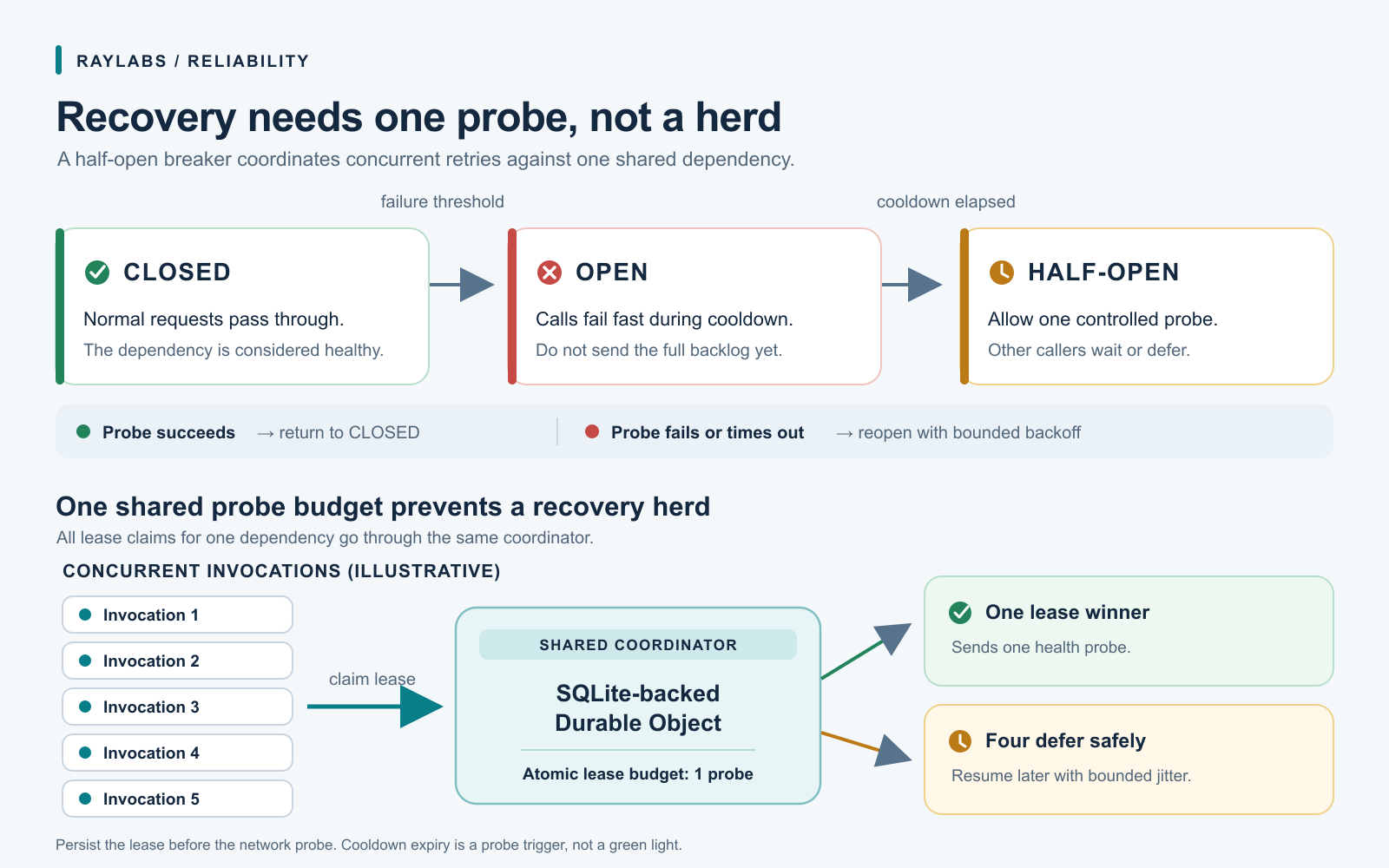
Managing dependency recovery in serverless architectures requires coordinating multiple concurrent invocations to prevent a thundering-herd problem when a service heals. Quick solution: Coordinate the half-open lease through a single SQLite-backed Durable Object per dependency, keep the network probe outside the transaction, and defer competing callers.
async function acquireProbeLease(storage: DurableObjectStorage, now: number): Promise<boolean> {
  return await storage.transaction(async (txn) => {
    const state = await txn.get("breaker_state");
    if (state && state.status === "open" && state.cooldownUntil > now) {
      return false;
    }
    const lease = await txn.get("probe_lease");
    if (lease && lease.expiresAt > now) {
      return false;
    }
    await txn.put("probe_lease", { expiresAt: now + 5000 });
    return true;
  });
}
A circuit breaker protects downstream dependencies by failing fast while an upstream service is unhealthy. The recovery window introduces a new risk when independent request handlers attempt recovery simultaneously. This race condition happens whenever multiple concurrent invocations share a dependency and coordinate through shared state. A scheduled invocation runs at its configured time rather than automatically fanning out into multiple triggers, but a sudden influx of traffic can create the same competitive pressure.
Understanding the Circuit Breaker States
A reliable serverless circuit breaker relies on three distinct operational states:
- Closed: normal traffic passes directly to a healthy dependency.
- Open: calls fail fast or defer while the dependency remains unhealthy.
- Half-open: after a cooldown period, the system admits a controlled probe instead of immediately restoring all traffic.
A successful probe closes the circuit breaker. A failed or timed-out probe reopens it and schedules another recovery attempt. A cooldown period represents a probe opportunity rather than a guarantee of full recovery.
Choosing a Coordination Boundary
Choosing the right coordination backend is essential for safe probe admission. Eventually consistent storage layers cannot provide the atomic guarantees required for single-probe coordination.
| Option | When to Use It | Trade-off or Failure Mode | Recommendation |
|---|---|---|---|
| Workers KV | Global read-heavy configurations | Eventually consistent, lacks atomic read-modify-write | Do not use for transactional lease locks. |
| SQLite-backed Durable Object | Single-region state consistency and transactions | Bound to a single location, requires routing | Recommended for single coordination points. |
| External Relational Database | Existing enterprise database clusters | Adds network latency to serverless invocations | Avoid if serverless cold-start and latency matter. |
A SQLite-backed Durable Object provides strong consistency and transactional guarantees for a single coordination point. Use a stable Durable Object identity for each protected dependency to manage lease admission in a short transaction.
Managing Recovery and Failure Handling
Leases must include an expiration timestamp so a crashed or timed-out claimant does not permanently block recovery. Callers that do not receive the lease should return a retryable or deferred outcome rather than spinning in a tight retry loop.
On a successful probe, close the breaker and clear the active lease. On a failure or timeout, reopen the breaker with an appropriate delay and jitter. For further reading on operational safety mechanisms, see Self-Expiring Kill Switches and Human-Readable Alerts.
Verification Checklist
- Issue five simultaneous lease requests against the Durable Object and verify that exactly one caller receives permission to probe.
- Confirm that expired leases allow a new claimant to acquire the probe slot after the timeout window elapses.
- Verify that late probe results from an expired lease do not overwrite newer breaker states in storage.
- Check that callers without a lease receive a deferred response rather than executing unauthorized network traffic.
Continue Exploring
You Might Also Like
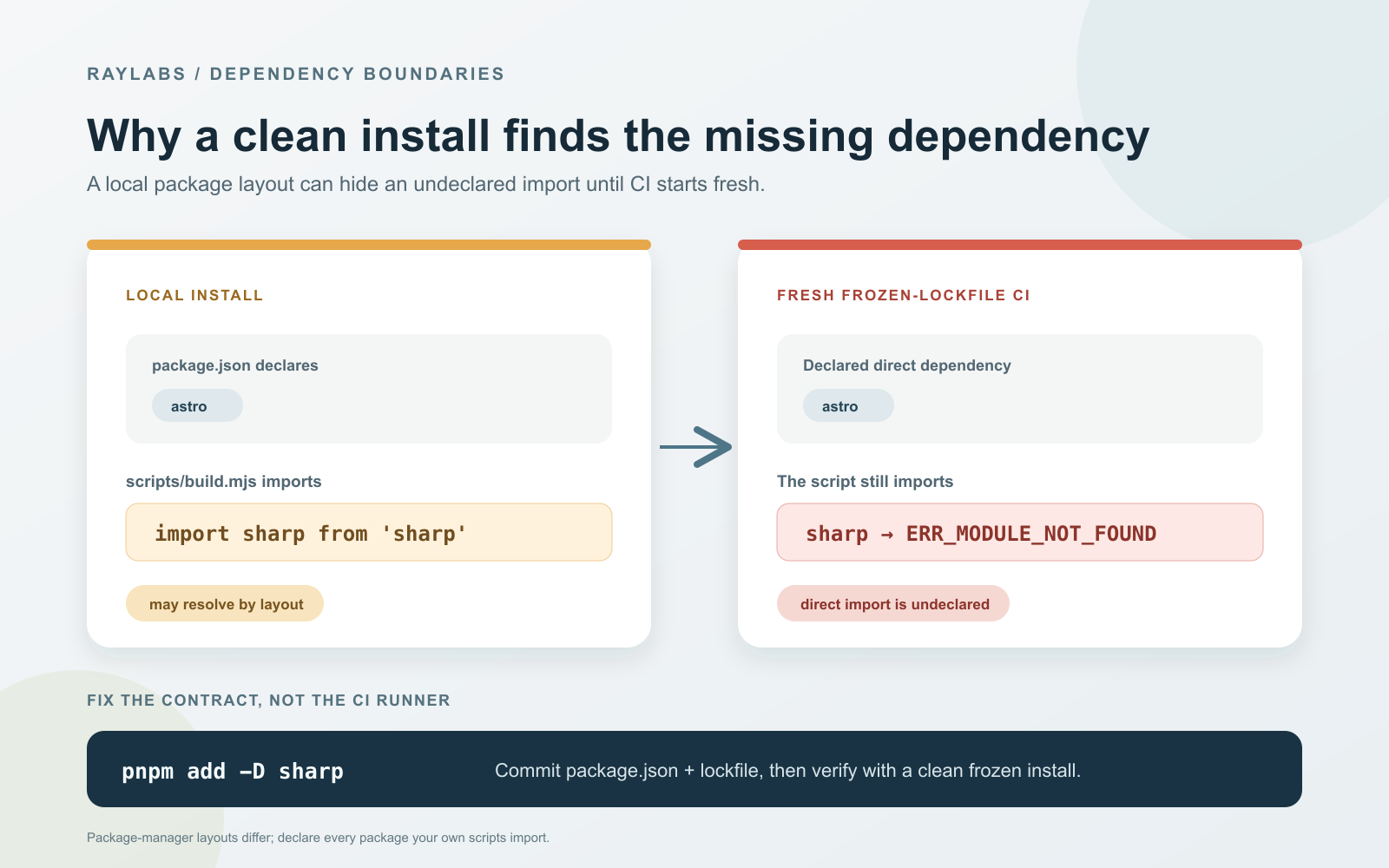
Fix pnpm Migration Phantom Dependency Errors
Learn how to diagnose and resolve ERR_MODULE_NOT_FOUND phantom dependency failures when transitioning from flat npm hoisting to strict pnpm in CI/CD pipelines.

Preventing ReDoS in Frontmatter Parsers
Learn how to avoid regular expression denial of service vulnerabilities in lightweight Markdown frontmatter parsers by replacing complex regex with bounded line scans.

Nightly Analyst Digest from Slot Activity Logs
Learn how to build a reliable scheduled digest email for high-frequency serverless cron systems, featuring local-timezone logging, fallback raw-stats reporting, and advisory-only recommendations.